
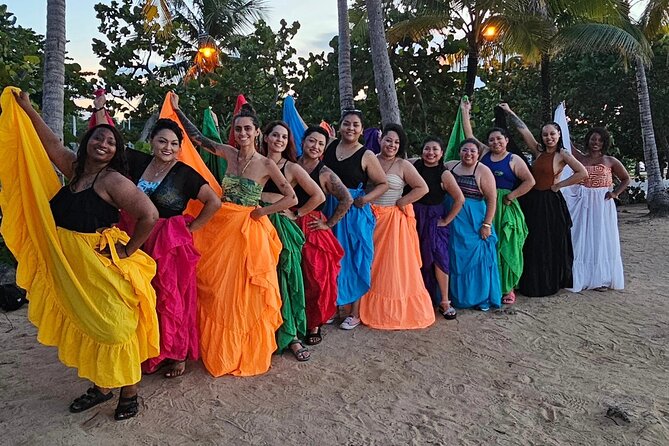
Review · WORKSHOPS
Afro Puerto Rican Folklore Bomba Class and Live Music
Puerto Rican Bomba is not just a dance you copy from an instructor. It is a conversation between dancer and drummer, with your movements setting up the rhythm and the drum answering back. At Ocean Park Beach, Jose Angel Catala and Charlotte Serrano introduce that exchange beside the statue in Parque Jose Celso Barbosa, often with the sea and sunset behind the class.
I like the live drumming and the way the lesson connects steps to Puerto Rican culture. I also like the friendly format: beginners can join in quickly, while traditional skirts, simple choreography, and plenty of encouragement help even shy dancers loosen up. The main drawback is practical: the meeting point can be confusing, and the outdoor, rocky ground is not ideal for every dance step.
Key points to know before booking
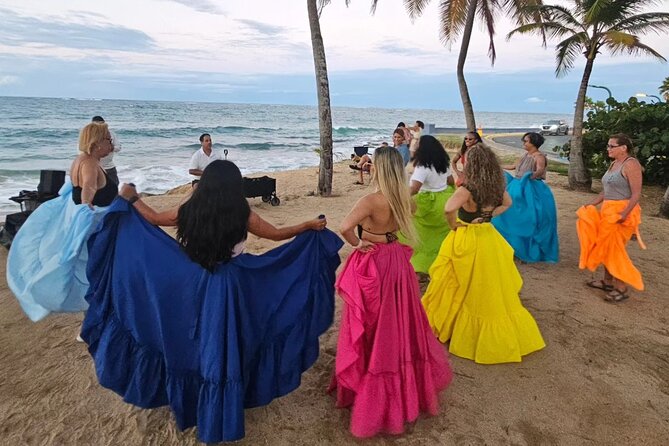
- Bomba is a musical conversation: Your body leads, and the drummer responds to your movement.
- The beach setting matters: Classes take place near Ocean Park Beach, with sunset often adding a memorable finish.
- Two experienced instructors lead the session: Jose Angel Catala has more than 20 years in Puerto Rican folklore, while Charlotte Serrano is a professional Puerto Rican dancer.
- Traditional skirts add color and movement: They help you feel part of the dance and make the lesson more fun for families and first-timers.
- The meeting point needs care: The class may be across the street and to the right of the statue, on the beach, so read your confirmation closely.
- Weather and minimum numbers can affect plans: Poor weather or too few bookings may lead to a new date or a full refund.
What Bomba means before you start dancing
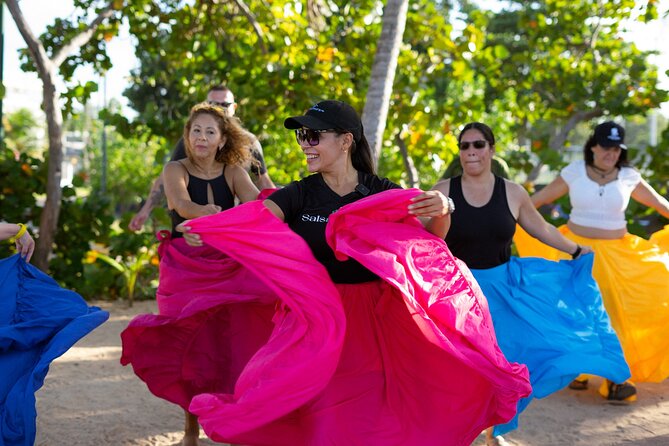
Bomba developed in Puerto Rico from African musical and dance traditions. It has long been tied to community gatherings and cultural identity, but you do not need prior dance training to take part.
The key idea is easy to understand and harder to master: the dancer makes a movement, and the drummer follows. In many dance forms, the musician sets the pace while the dancer follows. Bomba flips that relationship. Your gesture, footwork, or body movement gives the drummer something to answer.
That makes the lesson more than a sequence of steps. You are learning how the dance communicates. Charlotte or Jose may demonstrate a movement, explain its cultural meaning, then have the group repeat it with live percussion.
The class is designed for all skill levels. You can attend with no dance background, and the instruction remains open to people who already know salsa, folkloric dance, or other styles. The point is participation, not perfect footwork.
More Traditional Music and Dance Shows in the world:
- Budapest: Dinner Cruise with Live Music and Folk Dance Show
★ 4.4 · 2,090 reviews - Porto: The highest-rated traditional fado concert (downtown)
★ 4.8 · 1,557 reviews - Budapest: Hungarian Folk Dance & Concert with Dinner Option
★ 4.2 · 786 reviews
Meeting at Ocean Park Beach at 5:30 pm
The listed meeting point is Playa El Último Trolley, near Calle Park Boulevard and Cll Soldado Serrano in San Juan. The activity begins at 5:30 pm, but the actual dancing may begin later. The operator explains that the early call time allows people to find the group, put on skirts, and take photos before dark. One set of instructions describes the class itself as running roughly from 6:00 to 7:15 pm, while the activity is also described as about one hour.
That difference is worth noting. Check the confirmation message for the exact schedule on your date, and arrive early rather than treating 5:30 as the first drumbeat.
The location has caused some confusion. The directions refer to waiting by the statue, yet the class may actually gather across the street and to the right, on the beach. If you do not immediately see the instructor, look around the beach area and ask where the Bomba class is meeting. This is the one part of the experience that needs better handling.
The setting itself is a major part of the appeal. You are not in a sealed studio with artificial lighting and a mirrored wall. You are outdoors near the water, with room for music, skirts, and group movement. The ground can be uneven, with rocks and tree stumps, so wear shoes that are comfortable and secure. The same setting that gives the class its character can also make footwork less smooth.
Meeting Jose Angel Catala and Charlotte Serrano
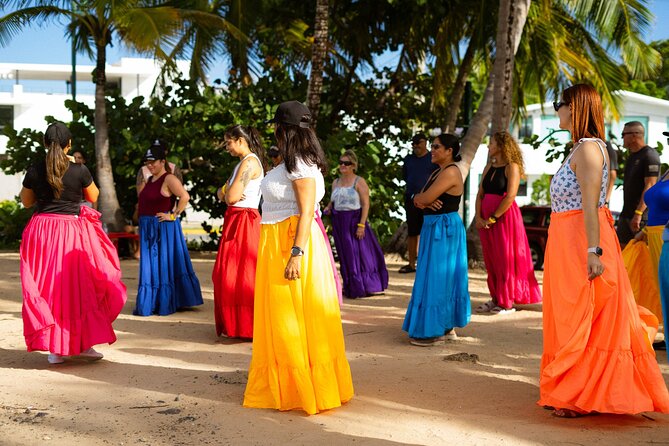
Jose Angel Catala brings more than two decades of experience as a Bomba dancer and musician in Puerto Rican folklore. That background matters because Bomba is easy to reduce to a few lively steps if the cultural context is left out. Jose’s role helps connect the movement to the music and to the traditions behind it.
Charlotte Serrano is a professional dancer from Puerto Rico with experience in several dance styles. Her teaching approach is energetic and encouraging, with enough challenge to keep the lesson interesting without making beginners feel out of place.
The best part of their roles is the balance between explanation and action. You get a short introduction to the origins and development of Bomba, then you move. The class is not a long lecture about folklore. It is a practical lesson in which the cultural background makes the dance easier to understand.
You may work with the group as a whole, follow demonstrations, and take turns showing movement while the drummer responds. The lesson is described as interactive, and the instructors aim to keep the energy going rather than stopping for long technical breaks.
Learning steps, rhythm, and the call-and-response
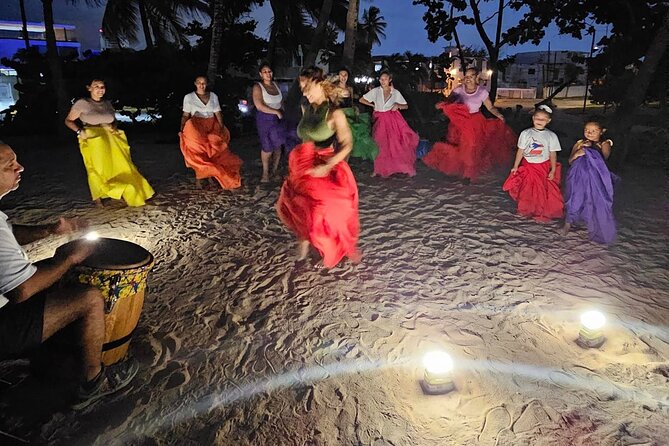
Expect a friendly introduction rather than a demanding dance workshop. The class welcomes curious beginners, families, and people with previous experience. You learn enough basic movement to join the group, then gradually add the style and attitude that make Bomba distinctive.
The live musician is essential. Recorded music could provide a beat, but it would not show the central relationship between dancer and drummer. With live percussion, the class can respond to the people in front of it. A simple movement becomes part of a musical exchange.
This is also where the class can get physical. The pace may stay active for most of the session, and you may work up a sweat. Bring water and expect to move, even though the experience lasts only about an hour or a little longer depending on the day.
The teaching is not built around flawless performance. The instructors encourage you to follow the rhythm and enjoy the process. That is good news if you are worried about looking awkward. Bomba rewards expression and response, not stiff precision.
More Workshops in the world:
- Mango’s Miami: Salsa Lessons, Mojitos, Bites & Live Music
★ 4.7 · 156 reviews - Kyoto: Japanese Koto & Shamisen Concert and Koto Class
★ 4.9 · 31 reviews - Venice: Cooking Class + Guitar Concert at Chef’s Francesco
★ 4.8 · 30 reviews - Cooking Class with Chef Francesco and Live Music in Venice
★ 5.0 · 10 reviews
Traditional skirts and the visual side of Bomba
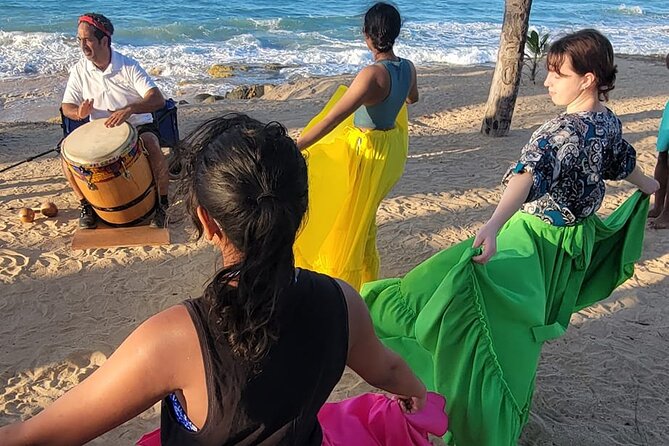
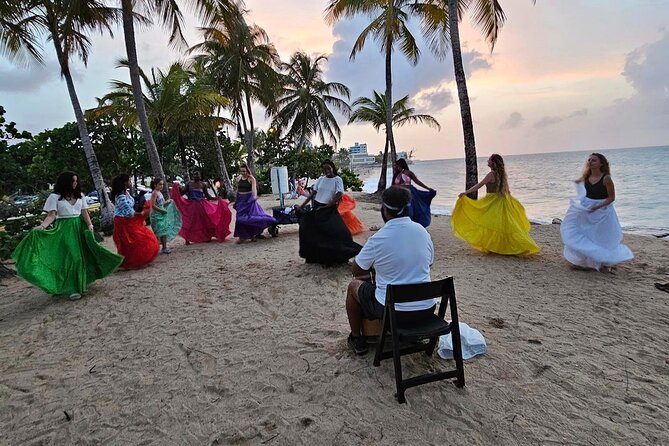
Traditional petticoat-style skirts are part of the fun. They add movement to the dance and help you see how a dancer’s body communicates with the music. Lifting and turning the skirt gives your arms another way to speak to the drum.
For many people, the skirts also make the class feel more ceremonial and communal. A basic step looks different when the fabric moves with it. Families and children may especially enjoy this part, and it gives the group a shared visual identity.
The skirts are not just a photo prop, though photos are part of the experience. They help show why Bomba is a dance of gesture and presence. You can see the rhythm in the feet, torso, arms, and fabric.
If photos or videos matter to you, the class may include opportunities to capture them. Do not let the camera take over, though. The strongest part of the session is the live exchange happening in front of you.
Sunset, beach air, and the imperfect floor
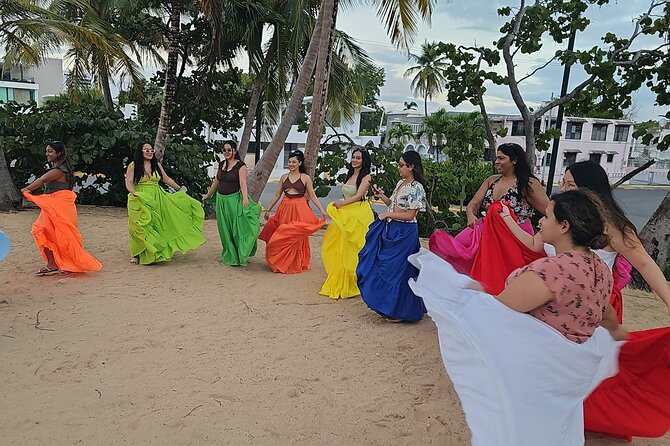
The sunset setting is one of the clearest reasons to choose this activity over an indoor dance lesson. A class near the beach gives the hour a sense of place, and the changing light can make the end of the session especially memorable.
The trade-off is the floor. Rocks and tree stumps have made it harder for some people to move freely. This is not a polished dance studio, and you should not expect a perfectly even surface.
Wear practical footwear and keep your steps controlled. If you have balance or mobility concerns, the uneven ground is more important than the dance itself when deciding if this fits your plans. Service animals are allowed, and most people can participate, but the outdoor surface remains a real consideration.
Weather is another factor. The activity requires good weather, and poor conditions can lead to a different date or a full refund. That policy makes sense for a beach class, but it also means you should avoid building a tightly packed evening around it.
Is $35 a fair price?
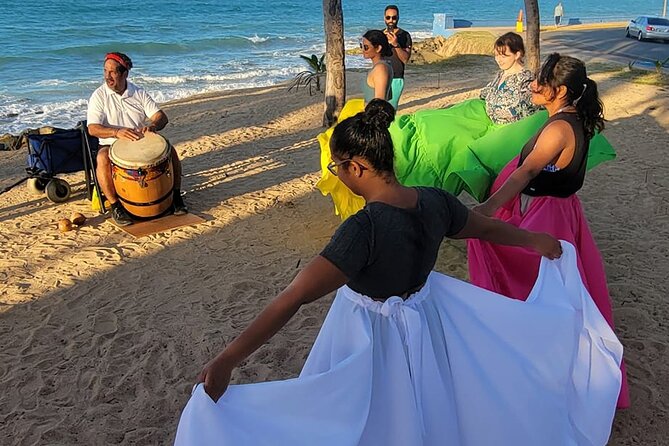
At $35 per person, this is a modestly priced cultural activity for San Juan. You are paying for instruction, live music, cultural explanation, and a distinctive outdoor setting, not just for access to a dance floor.
The value is strongest if you want a guided introduction to Puerto Rican culture. A casual beach stroll costs less, but it does not give you the chance to understand Bomba’s African roots, learn its basic movement, and experience the relationship between dancer and drummer.
The value is weaker if you want an intensive class. The lesson is short, and some people wish it lasted longer. You will get an enjoyable introduction, not a full course in Bomba technique.
A group of up to 20 people keeps the activity small enough for a shared class, though the exact feel may depend on attendance. Private group bookings are available, which could suit a family celebration or friends who want a more personal setting.
Who will enjoy this most?
I would choose this for you if you want culture with some movement rather than a museum-style explanation. It works particularly well for families, couples, groups of friends, and anyone who wants a memorable evening activity near the beach.
It is also a good choice for beginners who feel nervous about dance classes. The instructors make the setting welcoming, and you do not need previous experience. The emphasis is on joining the rhythm and responding to the music.
The class may be less suitable if you dislike public dancing, need a smooth floor, or want a long and technical workshop. It may also frustrate you if you expect the location directions to be obvious. Take a few minutes to confirm exactly where to stand before the start time.
The experience has been especially meaningful for families using it to mark a birthday or special occasion. The combination of music, costumes, teaching, and sunset gives the evening more weight than a standard one-hour activity.
Booking, cancellations, and practical planning
You can cancel for a full refund up to 24 hours before the start time. Changes made within 24 hours are not accepted, and the local time in Puerto Rico controls the cutoff.
If bad weather cancels the activity, you should be offered another date or a full refund. The same applies if the minimum number of participants is not reached.
The activity uses a mobile ticket, and confirmation is provided when you book. It is near public transportation, and service animals are allowed. The group size is capped at 20 people.
For the smoothest arrival, save the confirmation on your phone, note the 5:30 pm meeting time, and check the location details before leaving. Because directions have sometimes been unclear, allow time to find the group rather than arriving at the last minute.
Should you book this Bomba class?
Yes, if you want a short, affordable way to connect with Puerto Rican music and culture. The live drumming, beach setting, traditional skirts, and instructors’ energy give the class more character than a basic dance lesson.
Book with realistic expectations. You may dance on uneven ground, the class may be shorter than you wish, and the meeting point deserves careful attention. Read the confirmation, arrive early, and ask around the statue and beach area if the group is not immediately visible.
For most people, the chance to learn how the dancer leads the drum is worth the $35. This is not a polished stage show or a formal dance school. It is a friendly, active introduction to Bomba, with enough cultural context to help you understand what your body is doing.
FAQ
Where does the Bomba class take place?
The activity takes place near Playa El Último Trolley and Ocean Park Beach in San Juan, close to the statue in Parque Jose Celso Barbosa. The class may meet across the street and to the right of the statue, on the beach.
What time should I arrive?
The listed start time is 5:30 pm. The operator explains that this gives you time to find the group, put on skirts, and take photos before dark. The dancing may begin around 6:00 pm, so check your confirmation for the schedule on your date.
How long does the activity last?
The activity is listed as approximately one hour. The operator has also described the class portion as running from about 6:00 to 7:15 pm, so confirm the exact timing in your booking details.
Do I need dance experience?
No. The class is open to beginners and people with previous dance experience. The instructors teach the basic movements and encourage everyone to participate.
Who teaches the class?
Jose Angel Catala and Charlotte Serrano lead the experience. Jose has more than 20 years of experience in Puerto Rican folklore, and Charlotte is a professional Puerto Rican dancer.
Is live music included?
Yes. The class includes live drumming, which supports the call-and-response between the dancer and the musician.
Are traditional skirts provided?
Traditional petticoat-style skirts are used during the experience. They add movement and help participants take part in the visual style of Bomba.
Is the class suitable for families?
Yes. Most people can participate, and the activity has been used by families for special occasions. The ground is uneven in places, so consider that when deciding if it suits everyone in your group.
What happens if the weather is poor?
The activity requires good weather. If it is canceled because of poor conditions, you should be offered another date or a full refund.
Can I cancel my booking?
You can cancel up to 24 hours before the start time for a full refund. Cancellations or changes made less than 24 hours before the start time are not accepted.
Just added around the world
- Wrocław: Chopin & Friends piano concerts★ 4.6 · 28 reviews
- Warsaw: Guided Walking Tour with a Private Chopin Concert★ 5.0 · 13 reviews
- Warsaw: Candlelight Concert at Fryderyk Concert Hall★ 4.7 · 110 reviews
- Warsaw: Chopin Concert Ticket With Glass of Champagne★ 4.7 · 59 reviews
- Viva Blackpool: ABBA Bottomless Brunch with Live Music★ 5.0 · 2 reviews
- Waitangi: Treaty Grounds Hāngī and Concert Combo Pass★ 4.7 · 67 reviews
- Vienna: Concert by the Vienna Baroque Orchestra★ 4.6 · 56 reviews
- Vienna: Sunday Brunch Danube Cruise & Live Music★ 4.2 · 42 reviews
Workshops, compared.
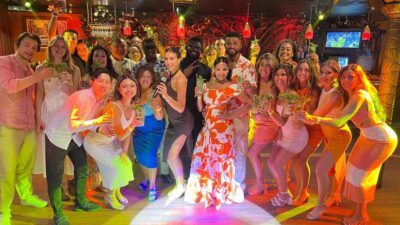
Mango’s Miami: Salsa Lessons, Mojitos, Bites & Live Music
Read our review →

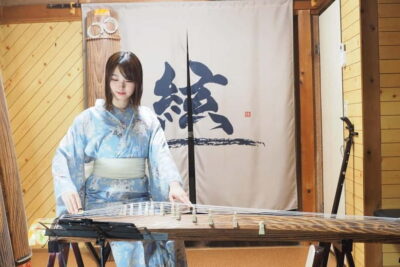
Kyoto: Japanese Koto & Shamisen Concert and Koto Class
Read our review →
Venice: Cooking Class + Guitar Concert at Chef’s Francesco
Read our review →
Original Sound of Music Tour & Edelweiss Cooking Class
Read our review →
Sound of Music Tour with Edelweiss Cooking Class in Salzburg
Read our review →
Browse the lists this tour appears in