
Review · ROME
Capuchins Crypt Tour and Concert in Rome
The most unusual part of this Rome evening is the pairing of a crypt decorated with thousands of Capuchin bones and a live a cappella concert of Renaissance sacred music. You move from the macabre to the meditative, with the Church of the Immaculate Conception, Caravaggio, and the friars’ story filling out the experience.
I like two things here. First, it gives you a different side of Rome than the usual ancient ruins and grand basilicas. Second, the four-part Schola Romana Ensemble, with soprano, alto, tenor, and bass, turns the visit into more than a museum stop. The main drawback is value: at $106.42 per person, it is costly for 90 minutes, especially if you skip the optional dinner.
The essential details at a glance
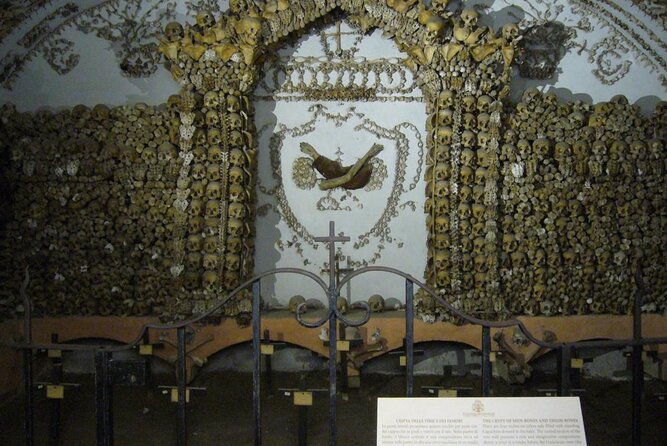
- Bone art unlike ordinary catacombs: The Capuchin Crypt uses about 4,000 friars’ bones in carefully arranged rooms, not simply rows of skulls.
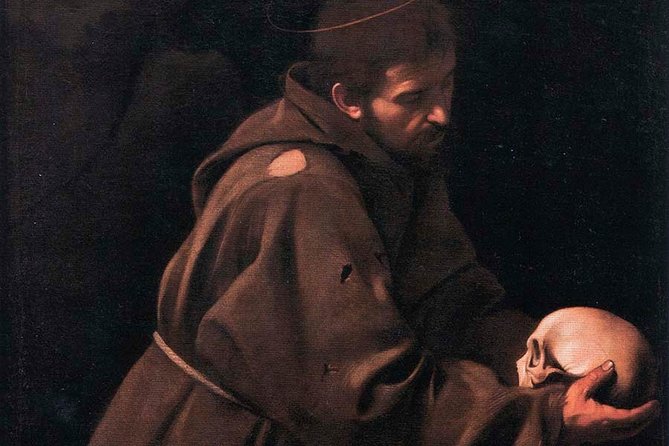
- Caravaggio in a small church: The museum includes Saint Francis in Meditation, along with works by Guido Reni, Domenichino, Pietro da Cortona, and others.
- Live Renaissance music: Schola Romana Ensemble performs works linked to the Sistine Chapel tradition, including music by Palestrina, Victoria, Morales, and Arcadelt.
- A compact afternoon program: The experience lasts about 1 hour 30 minutes and begins at 4:45 p.m. near Piazza Barberini.
- Small-group setting: The maximum group size is 30 people, with English used for the concert presentation.
- Dinner is optional: You can add a traditional Roman meal, with water and one bottle of wine for every two people included in that option.
Why the Capuchin Crypt is worth your time
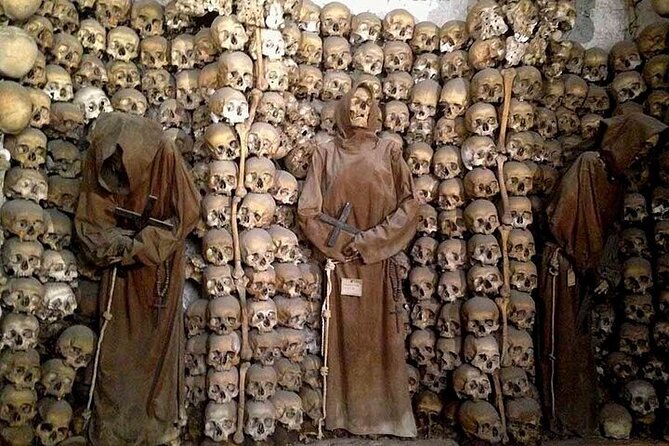
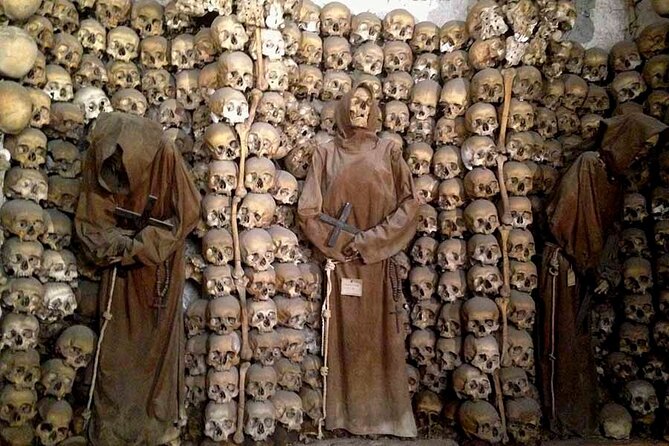
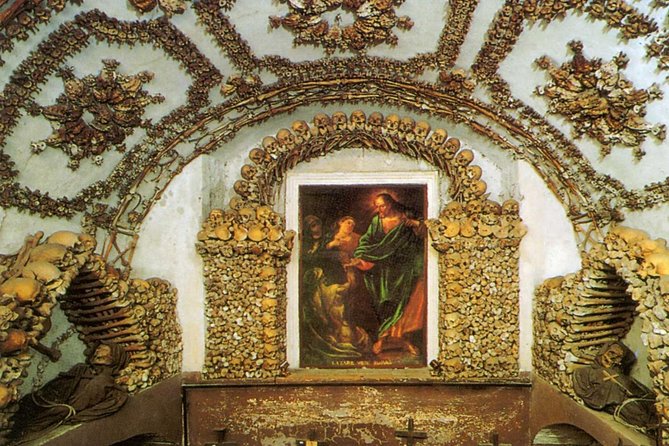
Rome has no shortage of churches, but the Capuchin Crypt is unlike almost anything else in the city. Beneath Santa Maria Immacolata, the remains of roughly 4,000 Capuchin friars have been arranged into chapels and decorative designs. The effect is strange, artistic, and at times unsettling.
This is not a simple wall lined with skulls. Each room has its own arrangement and meaning, and the bone work creates an atmosphere that can feel more contemplative than frightening. One inscription famously reminds visitors of the temporary nature of life, an idea that fits the Capuchin tradition of humility and mortality.
You should know what kind of experience this is before booking. The crypt contains genuine human remains, so it may not suit young children or anyone uncomfortable with memorial displays. The presentation is religious and reflective rather than a horror attraction. That distinction matters. The strongest part of the visit is not shock value, but the way the crypt connects art, faith, death, and the daily life of the friars.
The museum helps explain that setting before you go below. You learn about the Capuchin order and the church’s place in Rome. A well-prepared guide can make the rooms easier to understand, since the displays are more meaningful when you know why the friars created them.
The audio guide is available in 13 languages. It has been described as an interview-style program, which may feel more engaging than a standard recorded narration. Some outings have also included guides such as Angie, who was praised for explaining the church and crypt with warmth and clarity. Since the exact guiding format can vary, check your confirmation for whether your visit uses the audio guide, an in-person guide, or both.
A few more concerts around Rome worth a look
- Rome: “The Most Beautiful Opera Arias” Concert
★ 4.3 · 2,495 reviews - Rome: Opera Concert at Palazzo Poli – Fontana di Trevi
★ 4.7 · 1,026 reviews - Rome: The Three Tenors at St. Paul’s Church Concert Ticket
★ 4.7 · 699 reviews
Santa Maria Immacolata and its art
The church sits on Via Vittorio Veneto, one of Rome’s best-known streets. This is the Via Veneto associated with Federico Fellini’s La Dolce Vita, so the setting already gives you a small connection to modern Roman culture before you enter the church.
Inside, the decoration shifts from cinematic Rome to the art of the Counter-Reformation and the Baroque period. You may see works by Guido Reni, Domenichino, Pietro da Cortona, Gherardo delle Notti, and Antonio Sacchi. The church is not the largest or most famous in Rome, but it rewards a slower look.
The Caravaggio is the major art draw. Saint Francis in Meditation is a powerful image of the saint in prayer, with the plain, shadowed treatment that makes Caravaggio’s work so memorable. It is easy to rush toward the crypt and miss the painting, so give the museum and church their due.
I like this sequence because the church prepares you for the crypt. You first see how the Capuchins expressed their faith through paintings and architecture. Then you encounter the order’s unusual treatment of human remains. The two parts belong together, even though one is beautiful in the familiar sense and the other is beautiful in a much stranger way.
The concert: Renaissance voices in a quiet room
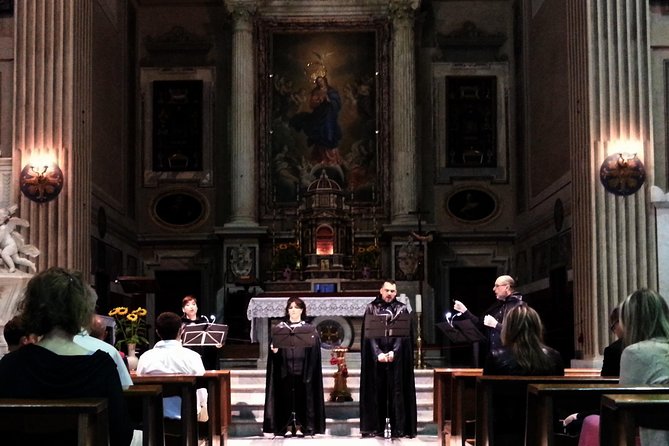
After the museum and crypt, the music changes the tone completely. Schola Romana Ensemble performs sacred music associated with the Sistine Chapel, including works by Giovanni Pierluigi da Palestrina, Jacobus Arcadelt, Cristóbal de Morales, Tomás Luis de Victoria, Felice Anerio or Pitoni, and Agazzari, along with Gregorian chant.
The ensemble uses four voices: soprano, alto, tenor, and bass, with a conductor. There are no instruments in the program as described. That means the sound depends on blend, balance, and the acoustics of the room.
The music presentation is in English, so you get some context before the singing begins. This is useful even if you know little about sacred music. A short explanation of a piece can show you what to listen for, whether that means the layered voices, the contrast between plainchant and polyphony, or the way the music was linked to Roman worship.
The performance is usually the emotional high point of the evening. The singers have been praised for their blend, sensitivity, and professional delivery. The sound can feel especially direct in a small hall, where four voices do not need to compete with an orchestra.
Set your expectations properly. This is not a full-length opera or an extended concert. Several people have wished the musical portion were longer, while still finding the singing excellent. If you want a two-hour recital, this will feel brief. If you want a concentrated introduction to early sacred music in a religious setting, the length works well.
Photography is allowed during the concert without flash. Video is not permitted. Flash photography has occasionally disturbed the lighting and mood, so please keep your phone tucked away unless you need one quiet, non-flash photograph.
How the 4:45 p.m. schedule works
The meeting point is Via Vittorio Veneto 21, near Piazza Barberini. Look for the entrance to Casa per Ferie I Cappuccini, directly on the street and across from the bus stop. This is not the same entrance as the Capuchin Museum, an important detail that can save you a hurried walk around the block.
Admission runs from 4:15 p.m. to 4:40 p.m. The official start is 4:45 p.m., and late arrivals are not accepted after that time. I would arrive at least 30 minutes early, as requested, especially if you are coming from another part of central Rome.
The location is near public transportation. Piazza Barberini is the useful reference point, with the meeting place on Via Veneto. The activity ends back at the meeting point, so you are responsible for arranging your own onward travel.
The 90-minute length fits neatly into a Rome afternoon. You can spend the morning at another major sight, have a late lunch, and then head to Via Veneto. It also works well near the end of a sightseeing day, since the concert offers a quiet change from Rome’s crowded streets.
The group can include up to 30 people. That is small enough to keep the experience manageable, though it is not a private tour. The provider has also described some guided portions as being handled in smaller groups, but the clearest published maximum for the complete activity is 30.
Same city, a different sound:
- Rome: Italian Opera Night Concert by Candle Glow
★ 4.6 · 630 reviews - Rome: The Four Seasons by Vivaldi
★ 4.7 · 595 reviews - The Great Opera Arias Concert at Palazzo Poli – Trevi Fountain
★ 5.0 · 533 reviews - Rome: Italian Opera Concert and Traditional Dinner
★ 4.1 · 453 reviews
Is $106.42 a fair price?
The listed price is $106.42 per person. That is a serious price for an hour and a half, and one person reasonably found the total experience expensive. The provider’s own direct price has been stated as €68 per person, so prices can vary by booking channel and date.
To judge the value, look at what is bundled together. You receive admission to the museum and crypt, the church visit, the audio guide or guiding service, an English introduction to the music, and the reserved concert. You are paying for a small cultural program rather than simply entering a museum.
The concert is what makes the cost easier to defend. A standard visit to the Capuchin Museum gives you access to the crypt, but not the live four-voice performance in the reserved hall. If the music is your main reason for booking, the package has a clear purpose.
Still, the price may not suit everyone. If you mainly want to see Caravaggio, a regular church visit is a cheaper way to build an art-focused afternoon. If you are already planning several concerts, guided walks, and paid museum entries in Rome, this outing may feel like one expense too many.
The optional Roman dinner changes the calculation. The details provided do not specify a menu or restaurant name, but the dinner option includes water and one bottle of wine for every two people. Transportation to the restaurant is not included, so ask for the exact dinner details before choosing the upgrade.
Getting to dinner after the concert
If you add dinner, plan the transfer yourself. The suggested route is to walk to Piazza Barberini, then take a taxi or bus. Bus lines 83, 63, 80, 160, and 492 are listed for travel toward Piazza del Plebiscito, followed by a walk of about 700 meters.
That is not difficult, but it is not a door-to-door transfer. Rome traffic can be slow, and a taxi may be the simpler choice if you are tired or carrying luggage. Since the concert ends back at the meeting point, you have a clear place from which to begin the next leg.
The dinner makes most sense if you want one organized evening and do not mind paying for convenience. If you prefer to choose your own trattoria, skip the upgrade and use the central location to find a restaurant near Barberini or elsewhere in the historic center.
Who will enjoy this experience most
I would choose this for someone who has already seen Rome’s headline sights, or for a first-time visitor who wants one evening that feels different from the Colosseum and Vatican routine. It suits people who enjoy religious art, unusual museums, choral music, and stories about how communities lived and worshipped.
It is also a good fit for music lovers who want to hear Renaissance polyphony without committing to a long concert. The English introduction helps if you are new to Palestrina or Gregorian chant.
I would think twice if you dislike human remains, have limited mobility that makes museum and crypt access difficult, or want a lively social evening. The mood is quiet and serious. The crypt is not a casual photo stop, and the music asks you to sit still and listen.
The experience is offered in English, and the audio guide has 13 language options. Most people can participate, and the meeting point is near public transportation. The supplied information does not give detailed accessibility notes, so contact the provider directly if stairs, walking distance, or seating are important to you.
Booking advice and final verdict
This is a good choice if you want one unusual Rome evening that joins art, mortality, and music. The Capuchin Crypt is worth seeing on its own, but the concert gives the visit a stronger arc. You begin with the Capuchin story, confront the bone artwork, and finish with voices that restore a sense of calm.
I would book it for the setting and the music, not just for the crypt. At $106.42, the price is high, and the concert is shorter than some people expect. But if the Schola Romana Ensemble performs well on your date, the combination is hard to reproduce with separate bookings.
Arrive early at the Via Veneto entrance, confirm the meeting location, and keep your expectations focused on a compact cultural program. Add dinner only if you want help shaping the rest of the evening. With free cancellation up to 24 hours before the start time, you have some flexibility, but late changes and late arrival are not accepted.
FAQ
Where does the Capuchin Crypt concert tour meet?
It meets at Via Vittorio Veneto 21, 00187 Rome, at the entrance to Casa per Ferie I Cappuccini. This is directly on the street, across from the bus stop, and is different from the entrance to the Capuchin Museum.
What time should I arrive?
Admission is from 4:15 p.m. to 4:40 p.m., with the activity beginning at 4:45 p.m. You are advised to arrive 30 minutes before the concert, and admission is not allowed after 4:45 p.m.
How long does the experience last?
The complete activity lasts approximately 1 hour 30 minutes and ends back at the meeting point.
Is the tour offered in English?
The musical program is presented in English. The Capuchin Museum and Crypt audio guide is available in 13 languages.
Can I take photographs during the concert?
Yes, photography is allowed without flash. Video recording is not allowed during the concert.
What happens if I need to cancel?
You can receive a full refund if you cancel at least 24 hours before the experience start time. Cancellations or changes made less than 24 hours before the start are not accepted for a refund.
Just added around Rome
- The Three Tenors Concert in St. Paul’s Within the Walls★ 4.5 · 49 reviews
- Rome: OPERA’S GREATEST HITS (Concert + Aperitif)★ 5.0 · 28 reviews
- Rooftop Bar Opera Show: The Great Beauty of Rome★ 5.0 · 92 reviews
- Freddie Mercury Opera Show in Rome★ 4.0 · 37 reviews
- Rome: Rooftop Gourmet Dinner & Opera Performance★ 5.0 · 4 reviews
- Opera Serenades in Palazzo Doria Pamphilj, Rome★ 5.0 · 27 reviews
- Rome: Chopin & Italian Friends Piano Concert★ 4.5 · 11 reviews
- Opera Concert Ticket in Rome with Dinner★ 4.0 · 52 reviews
Rome Concerts, compared.
Rome: “The Most Beautiful Opera Arias” Concert
Read our review →
Rome: Opera Concert at Palazzo Poli – Fontana di Trevi
Read our review →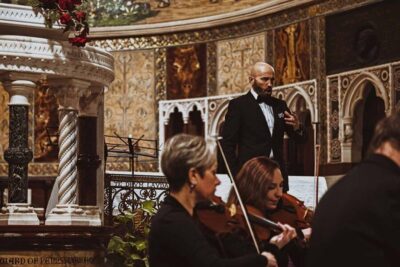
Rome: The Three Tenors at St. Paul’s Church Concert Ticket
Read our review →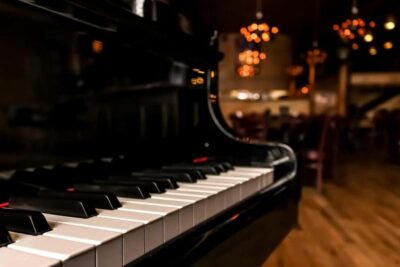
Rome: Italian Opera Night Concert by Candle Glow
Read our review →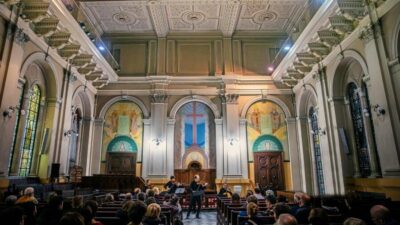
The Great Opera Arias Concert at Palazzo Poli – Trevi Fountain
Read our review →
Rome: Italian Opera Concert and Traditional Dinner
Read our review →
Browse the lists this tour appears in