
Review · PRAGUE
6 hours Musical Prague Private Tour by car
Prague’s musical story comes into focus on this six-hour private drive, linking Mozart’s opera house, Dvořák’s concert hall, Czech opera, Chopin, Beethoven lore, and John Lennon’s political wall. I like the way the route moves from grand interiors and concert venues to small personal traces, such as Ema Destinnová’s former home and the House at the Three Fiddles.
I also like the door-to-door transport, which saves you from piecing together far-flung sights, and the private guide, who can adjust the conversation to Mozart, Czech composers, opera, or modern music. The main caution is price: at $324.13 per person, this makes the most sense for a small group that values a private car and tailored commentary. Entrance fees are not included, and some stops may be viewed from outside.
Key points at a glance
- Mozart takes center stage: Visit the Estates Theatre, where Don Giovanni premiered, and connect the composer with St. Nicholas Church and Klementinum.
- Twelve stops fit into six hours: Expect about 30 minutes at each location, with travel time between districts included.
- A private car changes the pace: Hotel pickup and drop-off make it easier to reach Karlín, the opera houses, and other spread-out locations.
- Prague’s music story is broad: The route covers classical composers, opera singers, concert halls, musical theatre, political art, and even the sound of falling water.
- Personal needs can be discussed: Eva, the guide, and Jon, the driver, have accommodated a visitor with a badly injured leg.
- Budget carefully: The price includes transport, fuel, bottled water, and guide services, but not admission or lunch.
A six-hour route through Prague’s musical past
This is not a concert tour. You will not spend six hours seated in a hall listening to performances. Instead, you ride between places connected with composers, singers, theatres, concert halls, and Prague’s wider musical culture.
The day begins at 9am and lasts about six hours. A private air-conditioned minivan, or car, carries only your group. The route includes 12 named stops, each planned for roughly 30 minutes. That schedule gives you a useful overview, but it also means you should not expect a long guided visit inside every building.
Hotel pickup and drop-off are included. The listed meeting point is Prague Marriott Hotel on V Celnici, though pickup is offered, so confirm the exact arrangement when booking. Having a fixed morning start helps you make good use of the day, particularly if you want an orientation before attending a concert or opera later in your stay.
More Musicals in Prague:
- Disney’s Tarzan Musical
★ 5.0 · 3 reviews - NYC: Aladdin the Musical on Broadway
★ 4.8 · 1,800 reviews - NYC: MJ the Musical on Broadway
1,510 reviews
Nerudova and St. Nicholas Church: music in Little Town
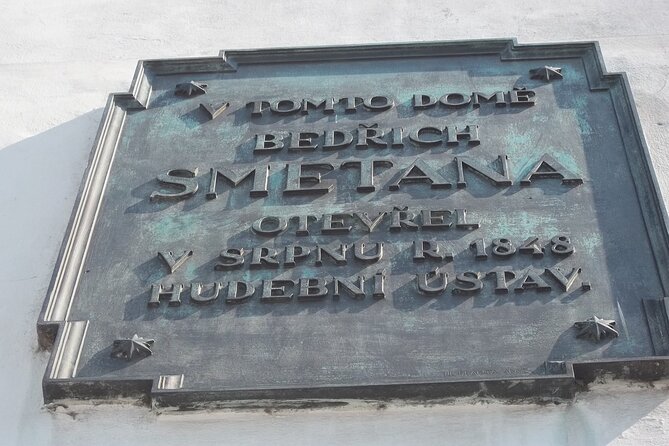
The first stop is Nerudova, one of Prague’s most attractive historic streets. The musical detail here is the House at the Three Fiddles, an engaging reminder that music appears in Prague’s architecture as well as in its concert halls.
You receive about 30 minutes at the stop, with no admission charge listed. This is more of a short historical pause than a full museum visit. Your guide’s explanation is important because the house itself does not offer a performance or a large exhibit.
The route then continues to St. Nicholas Church in Malá Strana. This grand Baroque church contains an organ built between 1745 and 1746. Mozart played it, and the instrument was later used during the requiem Mass for him.
This is the clearest early chance to enter a musical interior, but the admission fee is not included. Budget for that separately. The church is also a useful contrast to the later concert halls: here, the organ and sacred setting explain how music functioned in 18th-century Prague.
You have around 30 minutes at St. Nicholas. That is enough for a focused visit, though not a leisurely study of every decorative detail. If Mozart is your main reason for booking, tell your guide at the start so this stop receives the attention it deserves.
Ema Destinnová and the Lennon Wall
In Little Town Square, you see the house associated with Ema Destinnová, one of the most successful Czech opera singers of her era. Her career reached Berlin, London’s Covent Garden, and New York’s Metropolitan Opera, where she sang alongside Enrico Caruso.
This stop adds a human scale to the tour. Instead of hearing only about famous male composers, you connect Prague with a major female voice whose career crossed several countries. The visit is free and lasts about 30 minutes, though the focus is the exterior and the story rather than a dedicated museum.
Next comes the John Lennon Wall on Kampa Island. Its painted messages, romantic lines, philosophical writing, and portraits grew from the hippie movement and later became a way to express opposition to the communist regime after Lennon’s death.
The wall is not a classical music stop, and that is precisely why it earns a place here. It widens the idea of Prague’s music culture beyond opera and symphonies. Music becomes part of public protest and shared identity.
Your guide can also point out the large sycamore in the nearby garden of the Knights of Malta convent. It is sometimes called the Beethoven Sycamore, based on the local story that Beethoven liked sitting beneath it during his visit to Prague. Treat that as a legend, not a firmly documented event.
The Lennon Wall is free to see, and the 30-minute visit gives you time for photographs and context. If you prefer concert halls to modern street art, this may feel like the least essential stop. For many people, though, it supplies a welcome change of mood.
Rudolfinum and Dvořák Hall by the river
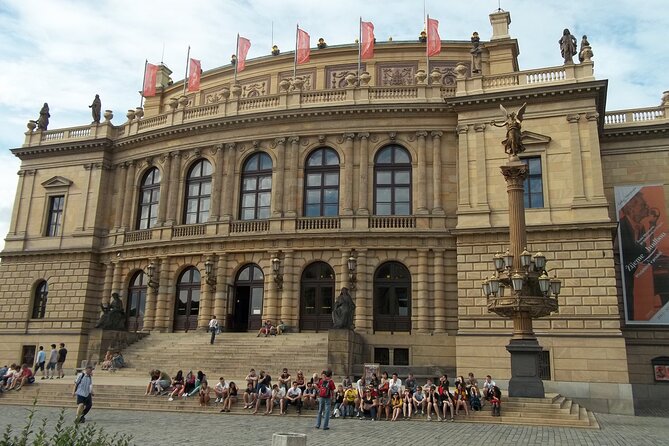
Rudolfinum is a Neo-Renaissance building beside the river and home to Dvořák Concert Hall. Its exterior, grand setting, and connection with Antonín Dvořák make it one of the route’s key classical music locations.
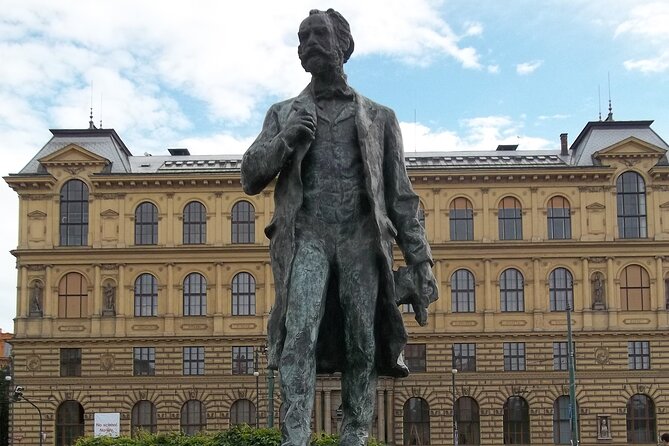
A statue of Dvořák stands in front of the building. It was unveiled at the end of the Prague Spring Festival in 2000. Dvořák later directed the National Conservatory in New York, beginning in 1892, an important chapter in the international story of Czech music.
The tour allows about 30 minutes here, with no admission included or listed. That timing works well for seeing the building and statue with a guide. It is not enough for a concert, rehearsal, or extended interior tour, so think of this as a focused introduction to the venue.
I find this stop especially useful if you plan to attend a concert in Prague. Your guide can place the hall within Dvořák’s career and explain why the building matters before you return for a performance.
A few more concerts around Prague worth a look
- Skip-the-line Lobkowicz Palace Private Tour & Concert
★ 3.2 · 3 reviews - VIP Jazz Dinner Cruise with Private Tour and Open Bar Option
★ 4.5 · 838 reviews - Sydney Half Day Private Tour: See Sydney Opera House and Bondi
★ 5.0 · 123 reviews - Little Havana Tour Private Cuban Podcaster Art, Museums, Music
★ 4.5 · 93 reviews
Klementinum and Mozart’s organ connection
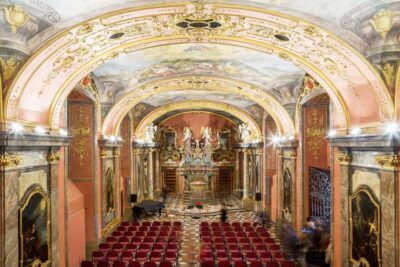
Klementinum is one of the Old Town’s largest historic complexes. Founded in 1232, it includes the Mirror Chapel, where concerts are held and where Mozart once played the organ.
The route gives you 30 minutes. The description includes the complex and the chapel, but entrance fees are not included, so ask your guide what access is available on your date and what you would need to pay. Do not assume that every interior area is included in the tour price.
Klementinum helps connect Prague’s architectural scale with its music. A church organ, a concert setting, and a centuries-old complex all meet in one stop. If you are keen on Mozart, this is one of the places to flag in advance, along with St. Nicholas Church and the Estates Theatre.
Estates Theatre and the Mozart centerpiece
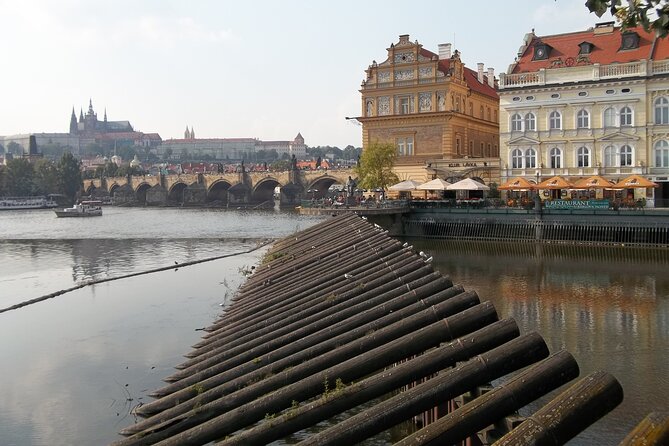
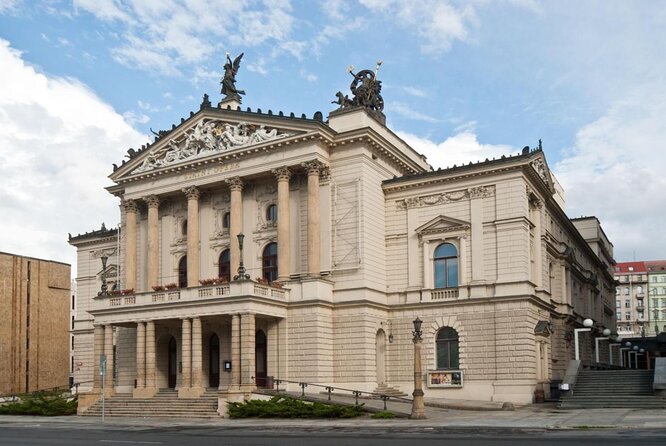
The Estates Theatre is likely to be the musical high point for many people. The elegant building opened in 1783 and remains close to its original condition. Mozart’s link here is unusually direct: Don Giovanni received its world premiere at the theatre, and the opera remains part of its repertoire.
You have about 30 minutes, and no admission is included. The tour description presents it as a sightseeing stop rather than a ticketed performance. A guide can explain the theatre’s Mozart connection, but you should arrange a separate performance ticket if you want to hear opera there.
The building’s preserved appearance gives the story real weight. This is not simply a plaque marking a famous composer. It is a functioning theatre with a specific work tied to its stage.
For a Mozart-focused itinerary, I would make sure the guide knows that this is a priority. The private format is valuable here because you can ask about Don Giovanni, Mozart’s Prague visits, and the theatre’s continuing role without being limited to a fixed group script.
Municipal House and the Smetana Concert Hall
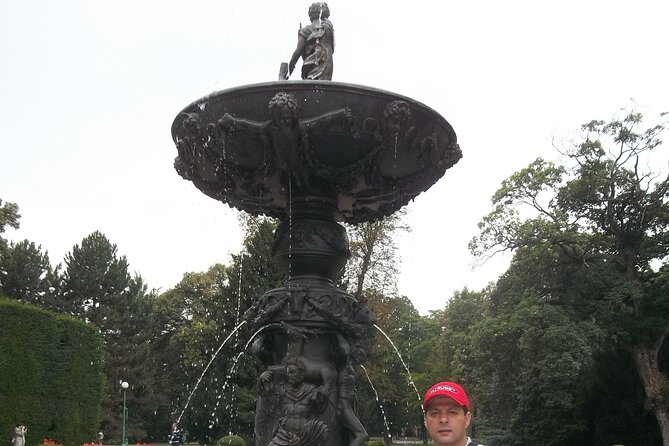
Municipal House brings you into Prague’s Art Nouveau period. It is one of the city’s most important Art Nouveau buildings and contains Smetana Concert Hall, its grandest concert venue.
Large orchestras perform there, so this is another stop with practical value for anyone planning an evening concert. You can recognize the exterior and understand the hall’s place in Prague’s performance life before returning later for music.
The route also points out a bust of Frédéric François Chopin. The Polish composer and pianist lived in Prague in 1829 and 1830. That small detail broadens the tour again: Prague was not only important to Czech composers, but also part of the working lives of major musicians from elsewhere in Europe.
About 30 minutes is assigned here, with no admission fee included. Since Municipal House contains more than one attraction, you may want to ask how much time will be spent on the building, the concert hall, and Chopin.
The Singing Fountain and sound in the garden
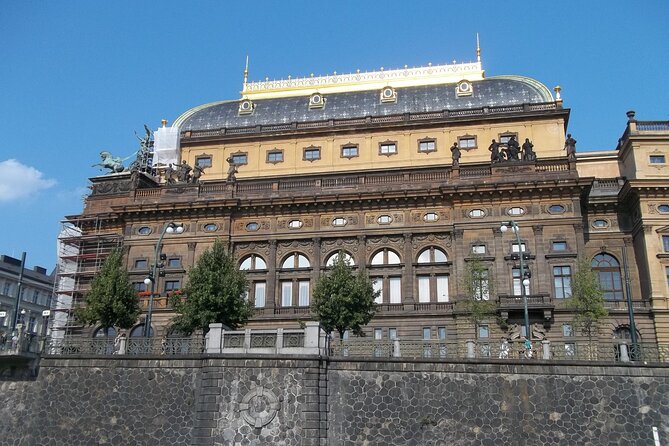
The Singing Fountain sits in the garden of the Summerhouse of Queen Anne. Water passing through the fountain creates a rhythmic sound as it falls onto a resonating bronze plate. It is described as one of the finest Renaissance fountains north of the Alps.
This is the most unexpected music-related stop. There is no composer to follow and no opera house to enter. Instead, you hear how architecture, water, and metal can create a musical effect.
The stop lasts about 30 minutes and admission is listed as free. It offers a quiet change after the formal concert buildings. The sound depends on the fountain’s operation, so I would treat it as a chance to see an unusual Renaissance feature rather than promise yourself a full performance.
National Theatre and State Opera
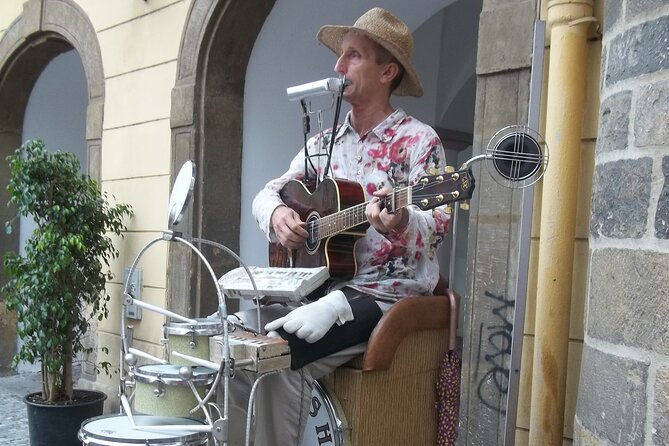
The National Theatre is known as the alma mater of Czech opera and is also a national monument of Czech art and history. Its three artistic companies are opera, ballet, and drama.
This stop is especially helpful if you want to understand how performance supported Czech language and national identity. The theatre represents more than a pretty façade or another concert venue. Its role is tied to the development of Czech cultural life.
You have roughly 30 minutes here. No admission fee is included, and the schedule does not promise an interior tour or a performance. Ask your guide what can be seen during your visit.
The State Opera gives you a second major opera house with a different origin. It opened in 1888 as the New German Theatre, was known as the Smetana Theatre from 1949 to 1989, and is now part of the Czech National Theatre system. It presents about 300 performances a year.
Together, these two stops show Prague’s opera tradition from two angles. The National Theatre represents Czech cultural purpose, while the State Opera reflects the city’s German-speaking theatre past and later institutional changes.
Karlín Musical Theatre and the final ride
The last listed stop is Musical Theatre Karlín, a theatre in the Karlín district devoted mainly to operetta and musical theatre. Built in 1881, it is now the second-largest theatre in Prague after the State Opera.
This stop keeps the tour from ending with opera alone. Musical theatre and operetta are part of Prague’s performance life too, and Karlín adds a more popular stage tradition to the route.
By this point, you will have covered a lot of ground. The private vehicle matters most here because Karlín is away from the central cluster of Little Town and Old Town sights. After the stop, you return to the meeting point, or to the arranged hotel drop-off.
What the $324.13 price gives you
At $324.13 per person, this is not a budget sightseeing ride. The value depends heavily on group size. A couple pays a substantial premium for privacy, but a small family or group can spread the cost while still receiving a private vehicle and dedicated guide.
The price includes fuel surcharge, bottled water, professional guide service, driver-guide service, air-conditioned minivan transport, hotel pickup, and hotel drop-off. Lunch is not included, and entrance fees are separate.
The strongest value is time. You can reach 12 music-linked places in six hours without arranging several tram rides, walking long distances between districts, or solving the route yourself. You also have the chance to ask for adjustments based on your interests.
The weaker value is depth. Thirty minutes at each stop is enough for an introduction, not a full visit to every theatre or church. If you want long interior tours, a complete museum experience, or a concert, you will need extra time and money beyond this outing.
One documented outing was handled by Eva as guide and Jon as driver. They adjusted the experience for a visitor whose husband had badly injured his leg and still wanted to see the Mozart and musical sights. That is a useful sign for anyone who needs a gentler pace, though you should explain mobility needs before the day begins.
Who should book this private music tour?
I would recommend it most strongly to a first-time Prague visitor with a serious interest in Mozart, opera, Czech composers, or concert architecture. It is also useful if you have only one full day for music and want a structured introduction before choosing an evening performance.
The private setup suits families, couples, and small groups who prefer questions and conversation over a fixed coach tour. Children can participate, but they must be accompanied by an adult, and the smart-casual dress code is worth following.
I would think twice if your priority is simply seeing Prague’s main sights. Much of the route is specialized, and some locations are brief exterior visits. You may get better value from a standard city tour if music is only a minor interest.
Free cancellation is available when you cancel at least 24 hours before the start time. Changes made inside that window are not accepted, so confirm your pickup details and any mobility requests early.
Should you book it?
Book this tour if you want Prague’s music story arranged around you, especially Mozart, Dvořák, opera, and historic concert halls. The private car, flexible guide, and hotel service make a long route practical, and the mix of classical landmarks with the Lennon Wall and Singing Fountain keeps the day from feeling one-note.
Skip it if $324.13 per person feels too high for short stops or if you want full access to every interior. For the right small group, though, it is a useful way to connect the city’s buildings, composers, performers, and political culture in one well-planned day.
FAQ
How long does the Musical Prague tour last?
The tour lasts approximately six hours and starts at 9am.
Is transportation provided?
Yes. Transport is provided by private air-conditioned car or minivan, with fuel surcharge included.
Is hotel pickup available?
Yes. Hotel pickup and drop-off are included. The listed meeting point is Prague Marriott Hotel on V Celnici, so confirm the exact pickup arrangement when booking.
Is this a private tour?
Yes. Only your group participates in the activity.
What is the price?
The listed price is $324.13 per person.
Are entrance fees included?
No. Entrance fees are not included in the tour price. St. Nicholas Church specifically lists admission as not included.
Is lunch included?
No. Lunch is not included, though it is available to buy.
Which Mozart sites are included?
The route includes St. Nicholas Church, Klementinum, and the Estates Theatre. The Estates Theatre is associated with the world premiere of Don Giovanni.
Can the tour be adjusted for musical interests?
Yes. The private format allows the tour to be customized to suit your musical interests.
Can children join the tour?
Yes. Children may participate, but they must be accompanied by an adult.
Just added around Prague
- Prague Super Saver: Lobkowicz Palace Concert plus Lobkowicz Palace Museum Entrance Ticket★ 4.5 · 77 reviews
- Organ Concert in St Francis Church Admission Ticket★ 4.5 · 88 reviews
- Prague: Mozart, Dvořák, Czech Folk Tour with a Guitarist★ 5.0 · 21 reviews
- Prague Old Town Tour with a Classical Concert★ 5.0 · 7 reviews
- Prague Walking Tour Following in Mozart’s Footsteps★ 3.0 · 14 reviews
- Lobkowicz Palace Concert in Prague Ticket★ 4.5 · 90 reviews
- Prague Reduta Jazz Club with Concert Ticket★ 4.0 · 42 reviews
- Classical Concert in St. Nicholas Church★ 3.0 · 39 reviews
Prague Concerts, compared.
Prague: Entry Ticket Classical Concert at the Mirror Chapel
Read our review →
Prague: A. Vivaldi Four Seasons at St. Salvator Church
Read our review →
Prague: Jazz Boat Popular Live Jazz Dinner Cruise
Read our review →
Prague: Mozart Ballroom Concert Ticket with 3-Course Dinner
Read our review →
Prague Castle: Midday Classical Concert at Lobkowicz Palace
Read our review →
Prague: Classical Concert in the Spanish Synagogue
Read our review →
Browse the lists this tour appears in